
this post was originally written several months ago after an article quoting Bill Gates about the need to raise taxes on the rich. I will post it here again. Some of the numbers and tax rates have changed, the ones in the blog are for explanation purposes.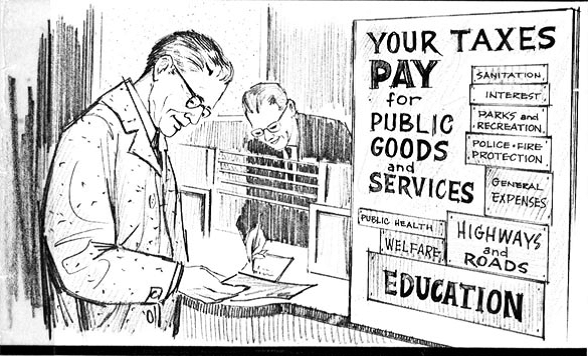
Why higher taxes are good.
This was prompted by an article where Bill Gates says higher taxes stimulate the economy. Bill Gates is not arguing to pay higher taxes; he is saying higher taxes on higher incomes stimulate the economy. This idea does not make sense to most Americans because the vast majority of us work for someone else. I will make five points to try to explain how higher taxes on higher incomes (a truly graduated income tax) stimulates the economy without, in fact, relying on the Government to do it (governments are bad at it anyway).
Part 1, A lot of people in the US and Canada (by far the majority) have only one source of personal income. In other words they work for someone else. At the end of the year their employer gives them a form (T4 in Canada, W2 in US) that states how much they were paid and what taxes were held back. They put these numbers in a tax form, do a little math, and know how much taxes they owe or get a refund of the taxes collected by their employers over the year. Tax forms say what they made and what they owe and that is it. There are some other things like deducting interest paid (in the US) on a house, or education expenses (in Canada) that adjust your taxable income but that is all. This is the basic chart for 2016 in the US for income levels (Canada is similar).
15% on 10,000 to 40,000
25% on 40 to 90K
28% on 90 to 190K
33% on 190 to 400K
If your net income falls inside the category listed that is what you have to pay. I am roughly in the 25% category with my job as a property manager. At my income level the Canadian rate is about the same. Looked at this way, I work for three months of the year for the government and watch in frustration what looks like waste, misdirection, and short sighted thinking that is being done with the fruits of my labors.
Part 2, my property management job is not the only income I have and this is where the tax picture begins to change. I have self-employed income (people still, occasionally, pay me to sing). Why does this matter? I get to write off the expenses of making my singing income from the income itself and thereby lower the tax bill on it. This is a partial list of write-offs: My tux and the cleaning of it, car mileage, insurance and repair (based on the percentage of usage for singing work), My piano, voice lessons, travel expenses to and from gigs, a portion of my rent, utilities, electricity, gas for heat (based on the percentage of office space in my house). Let us say for ease that all of this costs around $2000. Let’s say I made $3000 (I am not that popular). I take the income and subtract the expenses to create it and I pay taxes only on the $1000 left. If my tax rate is 25% I have saved $500 in taxes by having self-employed income. (25% of 3000 = $750, 25% of 1000 = $250) I have also stimulated the economy by buying a piano so the manufacturer, the retailer and the sales person all make more money. This is true for all the money I spent to make the singing income, the dry cleaner, the company that changes my oil, the my voice teacher.
Part 3, now, back to Bill Gates. He is not self-employed so where does the idea come from that higher taxes stimulates the economy? Another example will show it from my own income situation. I own some real estate of my own. Let us say for this discussion I have $100,000 of income per year from the renting out of these buildings. Now I am in trouble because I am in the higher tax bracket of 28%. (Range of $90 to 190,000) I need to spend at least $10,000 to get back in the lower tax bracket. As it stands this is easy because, like self-employment, I get to write-off all the expenses of the buildings against the income. There are in fact sixteen businesses I use to manage this property: landscapers, contractors (with sub-trades), property managers, bookkeepers, etc. I also pay property taxes, utilities, and fees. All of these expenses lower my taxable income. All of the people I pay have employees and all pay taxes on what I pay them. All of this stimulates the economy, employs people, and lowers my taxable income.
Part 4, In conclusion, if we add all my income up and all my write-offs against the income my taxable rate actually ends up in the 15% range, under $40,000. I have helped thirty or more small businesses improve their incomes. I have paid less in taxes making $150,000 than I would as an employee making $50,000. This is why Bill Gates knows raising taxes on higher incomes stimulates the economy. He makes around $9 billion per year. He lowers his taxable income by buying businesses, creating foundations, buying boats. He hires people to manage all of these assets. In his case, and people like Warren Buffett, they inoculate entire countries in the world against disease and they hire doctors, nurses, and support crews to do this.
Part 5, there is one more way to make money and avoid taxes. This way, however, in my opinion, does little to stimulate the economy (I admit to a bias here). The money made from stock and bond investments is called Capital Gains. The Capital Gains tax rate is roughly between 16 – 18%, (Notice this is 10% or less than income tax). People with “extra” income buy dividend paying stocks and bonds and only pay 18% on the dividend income. If you are making 9 Billion dollars a year, like Bill Gates, you put all your money in stocks and the money you are paid is taxed at a much lower rate. This money does not start new businesses; it does not employ more people. It does not create new businesses; it does not support existing small businesses. The money is in essence removed from the economy. The vast majority of us are living pay check to pay check and paying 25 – 33% of our income to the government. Roughly 87% of all income tax revenue, in fact, is paid by the middle class. Warren Buffett (another one of the richest men in the world) said once that he pays a lower tax rate than his secretary. He calls for a much higher Capital Gains tax rate, saying how ridiculous this rate is. He too, knows what stimulated the economy.
In short, raising taxes on wealthy people forces them to invest in things to avoid giving money to the government. This stimulates the economy. Since most of us work for other people the tax money still gets to the government but through a diverse and stimulated economy. Higher income people actually make more money this way and so does everyone else. Also raising the Capital Gains tax rate to close to the income tax rate would keep money in the economy that is now taken out through stocks and bonds.
This is a simplified explanation of how higher taxes stimulates the economy. Please comment or ask questions.

 Hark
Hark 